
Introversion, Extroversion, and Personality Measurement
Why the familiar Introvert / Extrovert distinction may combine several different personality traits that are more useful when measured separately.
People sometimes ask why introvert descriptions on SimilarMinds can appear more negative than extrovert descriptions. My answer is that Introversion and Extroversion, as commonly measured, are not clean single traits. They combine sociability with other characteristics—especially emotional stability, desire for external approval or status, stimulation seeking, and interpersonal style.
Two people can therefore receive similar Introversion scores for very different reasons. One person may be quiet because external recognition simply does not matter much to them. Another may be quiet because social situations are stressful or threatening. Their outward behavior can look similar even though the underlying personality dynamics are very different.
The Problem With the Standard Introvert / Extrovert Label
Most modern personality tests (including the Big 5) define Extroversion through items involving being outgoing, energetic, socially confident, enthusiastic, assertive, talkative, and comfortable with attention. The opposite pole therefore contains not only preference for solitude, but also lower enthusiasm, lower social confidence, lower assertiveness, and sometimes more negative affect.
That creates an interpretive problem. If a person scores as introverted, the score does not tell us whether they primarily prefer solitude, care little about status and attention, have low social energy, are emotionally less stable, dislike stimulation, or simply have little motivation to impress other people.
This is one reason I developed the MOTIVES personality system: to separate personality tendencies that are commonly bundled together inside broader labels.
Jung's Original Idea vs. Modern Introversion
Carl Jung's original Introversion / Extroversion distinction was broader and more conceptual than "quiet person versus social person." In simplified terms, Jungian Extroversion emphasizes orientation toward the external world, while Jungian Introversion emphasizes orientation toward the internal world.
Either orientation can be expressed constructively or dysfunctionally. An extreme external orientation can create excessive dependence on social approval, status, fashion, or outside values. An extreme internal orientation can create excessive detachment from external feedback or reality.
Preference and psychological health are separate questions. Wanting less social stimulation is not the same thing as depression, social fear, or low self-esteem. Likewise, enjoying social attention is not automatically a sign of psychological health.
What One Common Extroversion Item Actually Measures
Consider the item "I'm more outgoing than reserved." In SimilarMinds data, that item correlates with several MOTIVES dimensions rather than one clean underlying trait:
| MOTIVES Trait | Correlation |
|---|---|
| Materialistic | .335 |
| Offbeat | .239 |
| Thinking | -.052 |
| Interpersonal | .165 |
| Vital | .336 |
| Easygoing | -.093 |
| Sectarian | .090 |
The two strongest relationships here are with Materialistic and Vital. In other words, an "outgoing versus reserved" response partly reflects external reward/status orientation and emotional stability/positive affect in addition to sociability itself.
That is why the single word introvert often lacks enough descriptive precision. It tells you something about a person's typical outward behavior, but much less about the mechanism producing it.
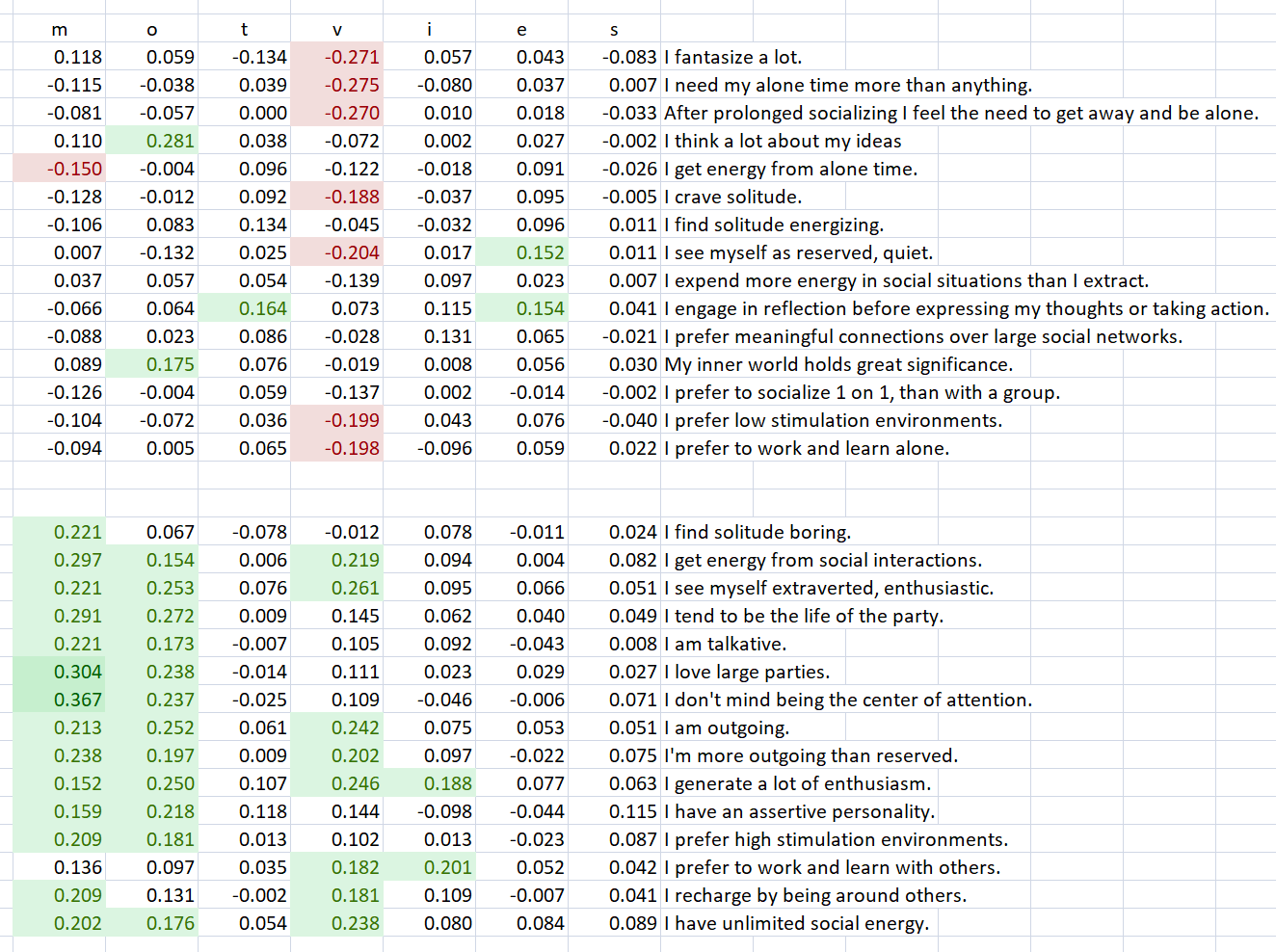
Original SimilarMinds item-correlation chart comparing common introversion and extroversion items with MOTIVES traits.
A Cleaner Introversion / Extroversion Spectrum
If emotional-stability differences are stripped away as much as possible, the contrast starts to look less like "unhappy loner versus happy social person" and more like low dependence on external value versus high dependence on external value.
Introvert / Ascetic-Leaning
- Appearance is not a major priority.
- I have little need for power over others.
- I prefer a basic or simple living space to a luxurious one.
- Power and recognition seem like shallow measures of success.
- I care less than most people about wealth, fame, and status.
- I do not feel a need to appear better than other people.
Extrovert / Materialistic-Leaning
- Being superior to others can feel rewarding.
- I gravitate toward people with prestige.
- Attractiveness and popularity matter to me.
- Beauty is highly important to me.
- It is important to impress people above me socially or professionally.
- External attention and recognition are rewarding.
Neither pole is automatically healthy or unhealthy. A person can be low in external-reward motivation while being confident, resilient, and socially comfortable. Another person can be highly externally oriented while also being emotionally healthy and socially effective.
Personality Preference vs. Emotional Health
It is more useful to separate what a person values from how well they are functioning emotionally. The same basic preference can look very different depending on emotional health.
Healthier External Orientation
- I don't mind being the center of attention.
- I am comfortable being visible in mainstream society.
- I like having my picture taken.
Less Healthy External Orientation
- I become jealous of people I see as better than me.
- My self-esteem depends heavily on how attractive I am to others.
- I become upset when external outcomes do not go my way.
Healthier Internal Orientation
- I do not worry much about my looks.
- I do not measure success by public opinion.
- I am emotionally steady and not easily upset.
Less Healthy Internal Orientation
- I minimize myself excessively.
- I become overly modest or self-effacing.
- I discount my own importance or value.
This distinction is important because evidence that a broad Introversion score correlates with lower well-being does not establish that solitude itself is unhealthy. It may instead reflect the way common tests combine solitude preference with low positive affect, social inhibition, low confidence, or other variables.
The MOTIVES View
Rather than treating Introversion / Extroversion as a single master dimension, MOTIVES separates several tendencies that can independently contribute to outward social behavior. Someone may be reserved because they are low in Materialism, low in Vitality, high in Thinking, low in Interpersonal, or some combination of these.
That produces a more complicated model, but it also allows two outwardly similar people to have very different underlying profiles. The goal is not to make every trait appear equally desirable. It is to measure personality dimensions as independently as possible and then examine how different levels relate to health, happiness, behavior, and other outcomes.
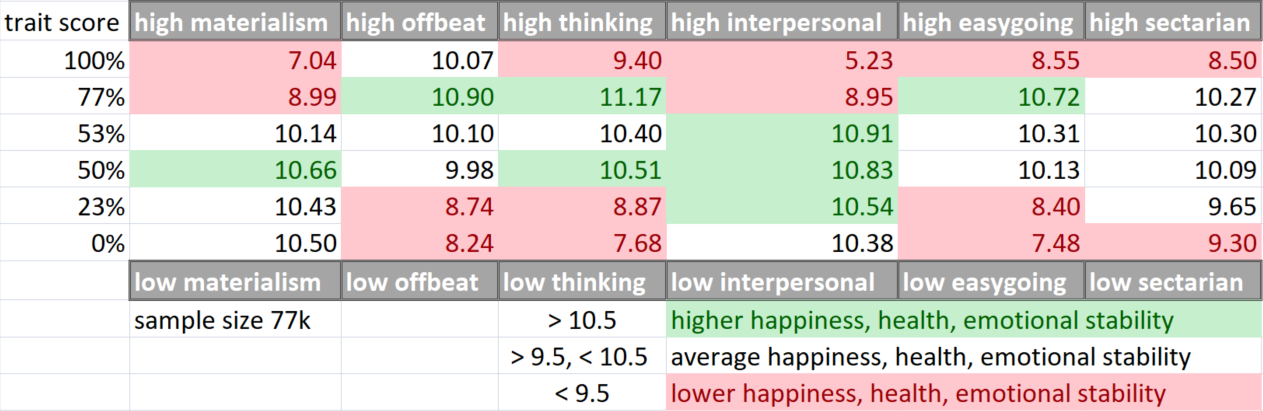
SimilarMinds MOTIVES comparison showing average Vitality / happiness levels at different trait-score levels.
In the SimilarMinds data summarized above, some personality dimensions show the highest average Vitality near the middle, while others show different patterns. This is one reason I prefer dimensional models over systems that assume every categorical personality type has an identical relationship with well-being.
Bottom line: Introversion is useful as a rough behavioral description, but it is too broad to explain why someone is reserved. Separating sociability, emotional stability, stimulation preference, status motivation, and interpersonal orientation produces a more informative picture.